
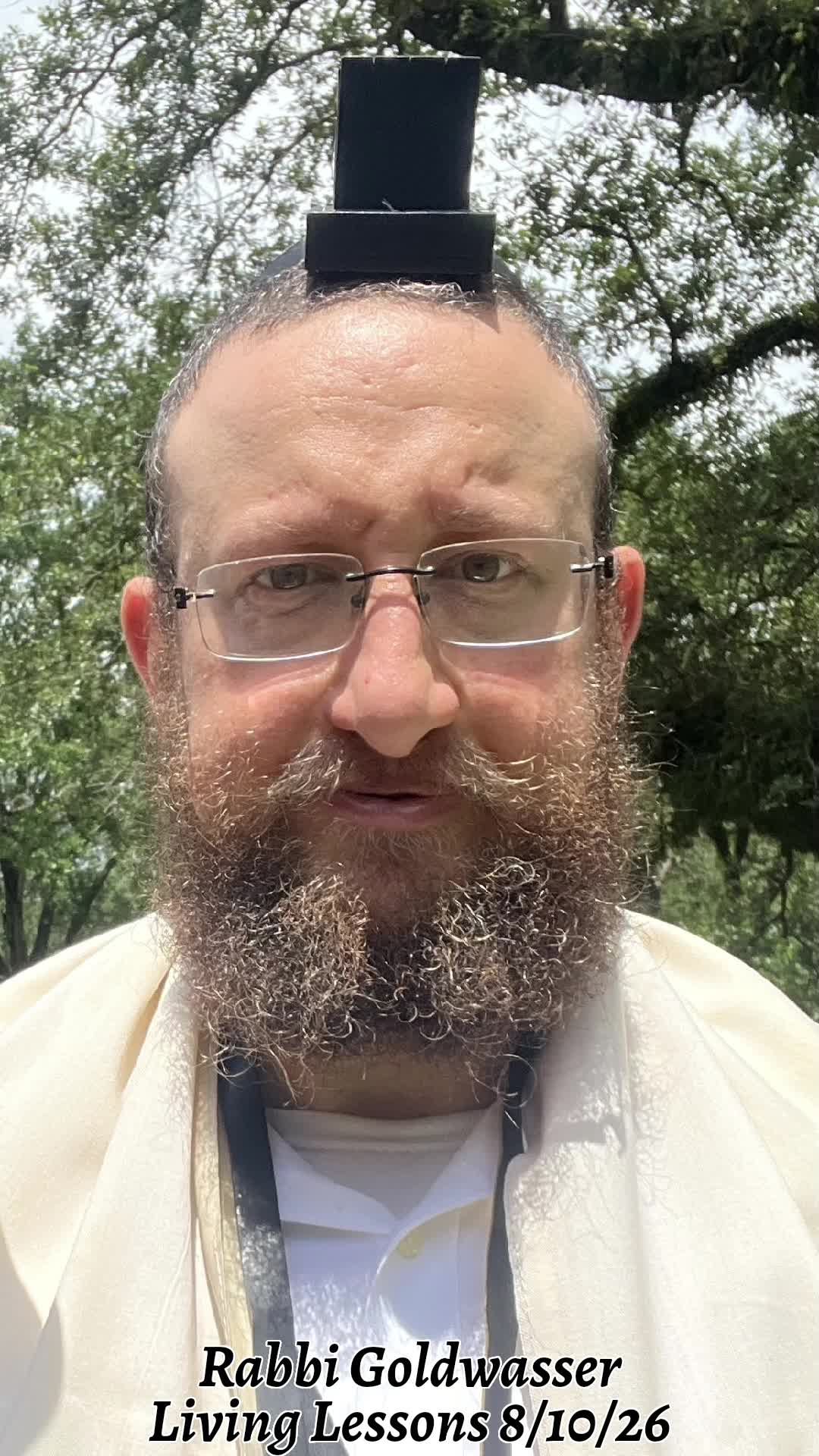
Rabbi Goldwasser Shabbat bites / posner
転記
Once, Rabbi Zalman Posner, a rabbi from Nashville, Tennessee, was interviewed on a radio show.
At a certain point, they took questions.
Whoever wanted could call up and ask whatever they wanted.
One of the callers asked Rabbi Posner, "How is it that Hashem cares about such minute details?
Why is it that in the Torah it says that if you light a match on Shabbos, there is a harsh punishment?
Or eating dairy is fine, or eating meat is fine, but if you mix the two and eat them together, then there's a very harsh punishment.
Why does Hashem care about all these small little details?
Why can't we just live and let live?
To this question, Rabbi Posner answered that in order for beis din, the Jewish court, to actually carry out a punishment, there needs to be witnesses.
The witnesses have to warn the person that he is not allowed to do what he's doing, and if he does it, he's going to get that specific punishment.
And then, after being warned, the person needs to go ahead and do that sin again within a very short amount of time, and only then will the person get the punishment.
Upon hearing about this interview, the Rebbe said that we should take a look at current events and we will have a much stronger answer.
This interview took place in 1968, a short while after the Apollo 8 mission successfully went to the moon.
The Rebbe said, imagine, for thousands of years the world is waiting for people to go to the moon.
Finally, they have the spaceship ready They have the astronauts with everything that they need.
They're just a few minutes away from the moon, and one of the astronauts takes out a lighter and a cigarette and wants to start smoking.
Would it make sense for him to say, "Live and let live, let me light my match, let me smoke my cigarette"? Of course not.
By doing so, not only will you explode the whole spaceship and finish the lives of all the astronauts, but also you will ruin this moment that the whole entire world was waiting for for thousands of years for humans to come to the moon.
Similarly, the world is waiting for Moshiach.
Every mitzvah that we do brings him closer.
For over 5,000 years, we're working on preparing the world for Moshiach to come.
When we have the opportunity to either do good or do bad, it's not a situation that we could say live and let live.
Rather, we need to see the importance of each and every action that we do and the great accomplishments that it could have for the whole entire world.
This week's Torah portion starts off בהוא יעקב תשבון. And it will be because you have listened to what Hashem said, and that's why Hashem is giving you all these blessings.
But "akev" has another meaning.
"Akev" is a heel.
The rabbis teach us that in order to properly serve Hashem, we need to do the mitzvahs that a person would normally trample with his "akev," with his heel.
We can't just say, "Oh, this mitzvah, it's not so important.
It's a small little detail.
What does Hashem care anyway?
" Rather, we need to see the importance and responsibility we have with every decision that we make, for each and every action that we do.
Let us view our actions with that lens.
Let's realize that we are at the culmination of a journey that lasted thousands of years, and it could be your mitzvah that will tip the scale and bring Mashiach.
May we merit his coming speedily in our days.
Adai sh'ma'arachah.
At a certain point, they took questions.
Whoever wanted could call up and ask whatever they wanted.
One of the callers asked Rabbi Posner, "How is it that Hashem cares about such minute details?
Why is it that in the Torah it says that if you light a match on Shabbos, there is a harsh punishment?
Or eating dairy is fine, or eating meat is fine, but if you mix the two and eat them together, then there's a very harsh punishment.
Why does Hashem care about all these small little details?
Why can't we just live and let live?
To this question, Rabbi Posner answered that in order for beis din, the Jewish court, to actually carry out a punishment, there needs to be witnesses.
The witnesses have to warn the person that he is not allowed to do what he's doing, and if he does it, he's going to get that specific punishment.
And then, after being warned, the person needs to go ahead and do that sin again within a very short amount of time, and only then will the person get the punishment.
Upon hearing about this interview, the Rebbe said that we should take a look at current events and we will have a much stronger answer.
This interview took place in 1968, a short while after the Apollo 8 mission successfully went to the moon.
The Rebbe said, imagine, for thousands of years the world is waiting for people to go to the moon.
Finally, they have the spaceship ready They have the astronauts with everything that they need.
They're just a few minutes away from the moon, and one of the astronauts takes out a lighter and a cigarette and wants to start smoking.
Would it make sense for him to say, "Live and let live, let me light my match, let me smoke my cigarette"? Of course not.
By doing so, not only will you explode the whole spaceship and finish the lives of all the astronauts, but also you will ruin this moment that the whole entire world was waiting for for thousands of years for humans to come to the moon.
Similarly, the world is waiting for Moshiach.
Every mitzvah that we do brings him closer.
For over 5,000 years, we're working on preparing the world for Moshiach to come.
When we have the opportunity to either do good or do bad, it's not a situation that we could say live and let live.
Rather, we need to see the importance of each and every action that we do and the great accomplishments that it could have for the whole entire world.
This week's Torah portion starts off בהוא יעקב תשבון. And it will be because you have listened to what Hashem said, and that's why Hashem is giving you all these blessings.
But "akev" has another meaning.
"Akev" is a heel.
The rabbis teach us that in order to properly serve Hashem, we need to do the mitzvahs that a person would normally trample with his "akev," with his heel.
We can't just say, "Oh, this mitzvah, it's not so important.
It's a small little detail.
What does Hashem care anyway?
" Rather, we need to see the importance and responsibility we have with every decision that we make, for each and every action that we do.
Let us view our actions with that lens.
Let's realize that we are at the culmination of a journey that lasted thousands of years, and it could be your mitzvah that will tip the scale and bring Mashiach.
May we merit his coming speedily in our days.
Adai sh'ma'arachah.
